It's been a great field season so far. I arrived in Peru on July 16th and nearly immediately headed to Casma. Casma is about 470 km north of Peru's capital city, Lima. Since Casma, like Lima, is on the coast, it's a foggy desert. The dry conditions mean that the archaeological preservation here is quite good. In previous years I've recovered cloth, whole avocados, seeds, and even a desiccated fish head from archaeological contexts over 700 years old. The fog means that the mornings are cool and damp (as are the evenings sometimes), and the coastal location means that ancient people relied in part on the sea for their subsistence, as do modern people.
This field season is a non-invasive exploratory field season. I've been taking photos and leaving only footprints. In accordance with Peruvian law, I have not been collecting artifacts. Observations and photos provide plenty of information for planning a multi-year excavation project for the near future, ideally beginning next June or July.
In the interest of preserving the archaeological sites, I won't publish their exact locations at this time. But I can explain - in general terms - what I've been up to.
I've largely been exploring the Sechin branch of the Casma River Valley, looking for later-period archaeological sites that will provide fruitful data for advancing our knowledge of the Casma Polity, pre-Hispanic cities and their hinterlands, and how villages, neighborhoods, and other kinds of communities interact and change over time. For some comparative data, I've also been visiting a few sites in the Casma branch of the Casma River Valley.

'Exploring' isn't exactly the best word to use to describe my field research this summer. Exploring sounds like I'm out there fishing for shiny artifacts! Rather, I've been systematically working my way down the valley between two well-known villages. As I make my way, following ancient trails and irrigation canals at the edge of the irrigated valley floor, I look for signs of ancient habitation. Specifically, I'm interested in settlements that might have been occupied before, during, and after the site of El Purgatorio (ca. AD 700-1400 [Vogel 2012; Vogel and Pacifico 2011]) and especially before, during, and after Purgatorio's commoner residential district, Sector B (Pacifico 2014).
There are a couple of key clues that one might find on the surface that tell us the who, what, and when of archaeological sites. First, you're likely to see human-made walls that have survived from long-abandoned buildings. Walls are usually made of piled stone. Sometimes they have mortar, and occasionally they're made of adobe. Walls don't have to stick up out of the ground, either. A lot of the walls in this area are retaining walls that supported large settlements climbing way up the foothills of the Cordillera Negra here. If you can imagine what a Brazilian favela might look like, you start to get an idea of what a lot of the late-period (ca. AD 1000-1400) settlements looked like in this area. Now imagine that all the favela's houses have been removed. That's what you might see today.
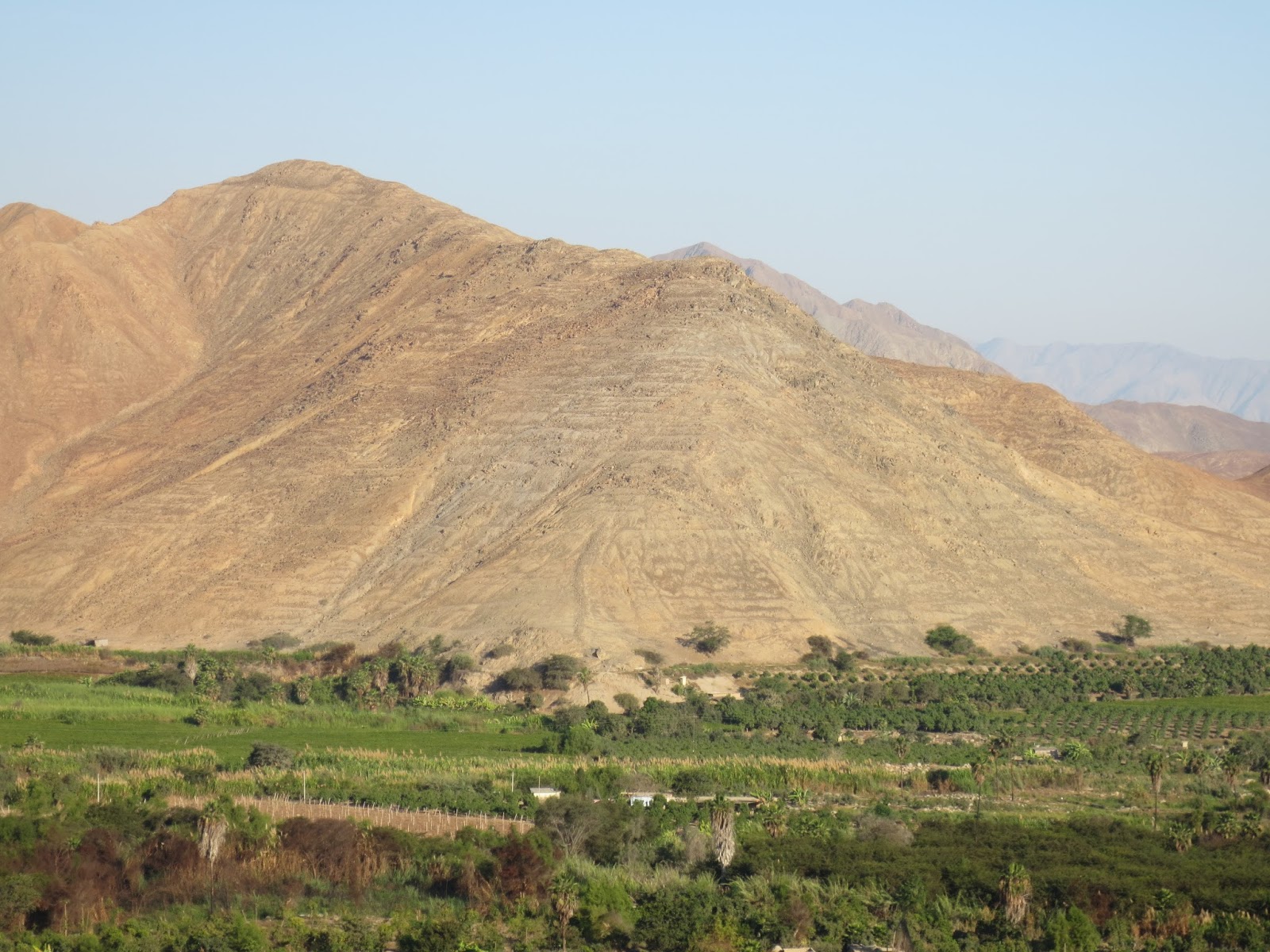 |
| Horizontal striations on this mountain are likely ancient residential terraces |
You're also likely to see two or three kinds of 'portable' artifacts on the surface. The most telling artifacts are decorated ceramic fragments. If you're lucky, you get fragments with really clear 'diagnostic' elements on them. For example, from my experience I know that certain ceramic decorative motifs are typical of 12th-15th century Casma Polity settlements. Incised circles and dots are very diagnostic of Casma Polity settlements. When I find those on the ground, I've got a good clue that the site I'm at was occupied, visited, or in contact with the people at El Purgatorio sometime between the 12th and 15th centuries.
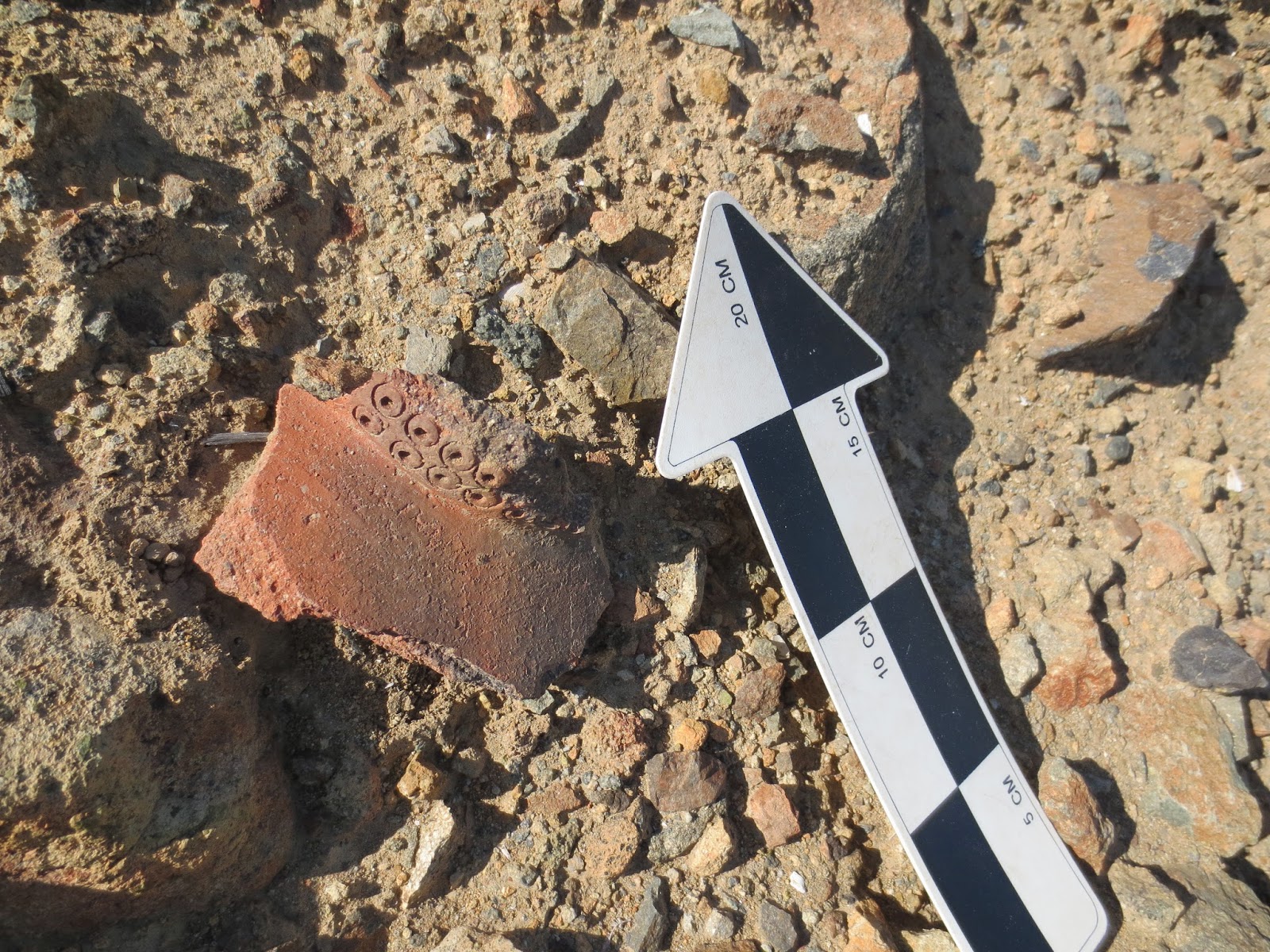 |
At center-left you can see a ceramic fragment,
probably the shoulder of an olla or cooking pot,
with the incised circle-and-dot characteristic of later-period Casma Polity sites |
In addition to ceramic fragments, marine shells and bones (usually human). Marine shells are important indicators of human settlements because the middle sections of the Casma River branches are approximately 30km from the sea. If you find marine shells there, you know that someone hauled them 30km to get to the mid-valley, and then hauled them uphill. That's a pretty intensive effort that indicates a complex and extensive trade network for marine foods. It also indicates that the site you're at was a storage, habitation, or food processing site - or some combination.
Bones appear on the surface a lot, too. Bleached bones have been sitting on the surface a long time. Human bones tell you that you're at a site that was used as a cemetery. Unfortunately, the reason they're on the surface is that lots of cemeteries have been subject to unauthorized digging, locally called huaqueo. Another word for unauthorized digging is 'looting.' I choose to use the term unauthorized digging, or better huaqueo, for reasons explained elsewhere.
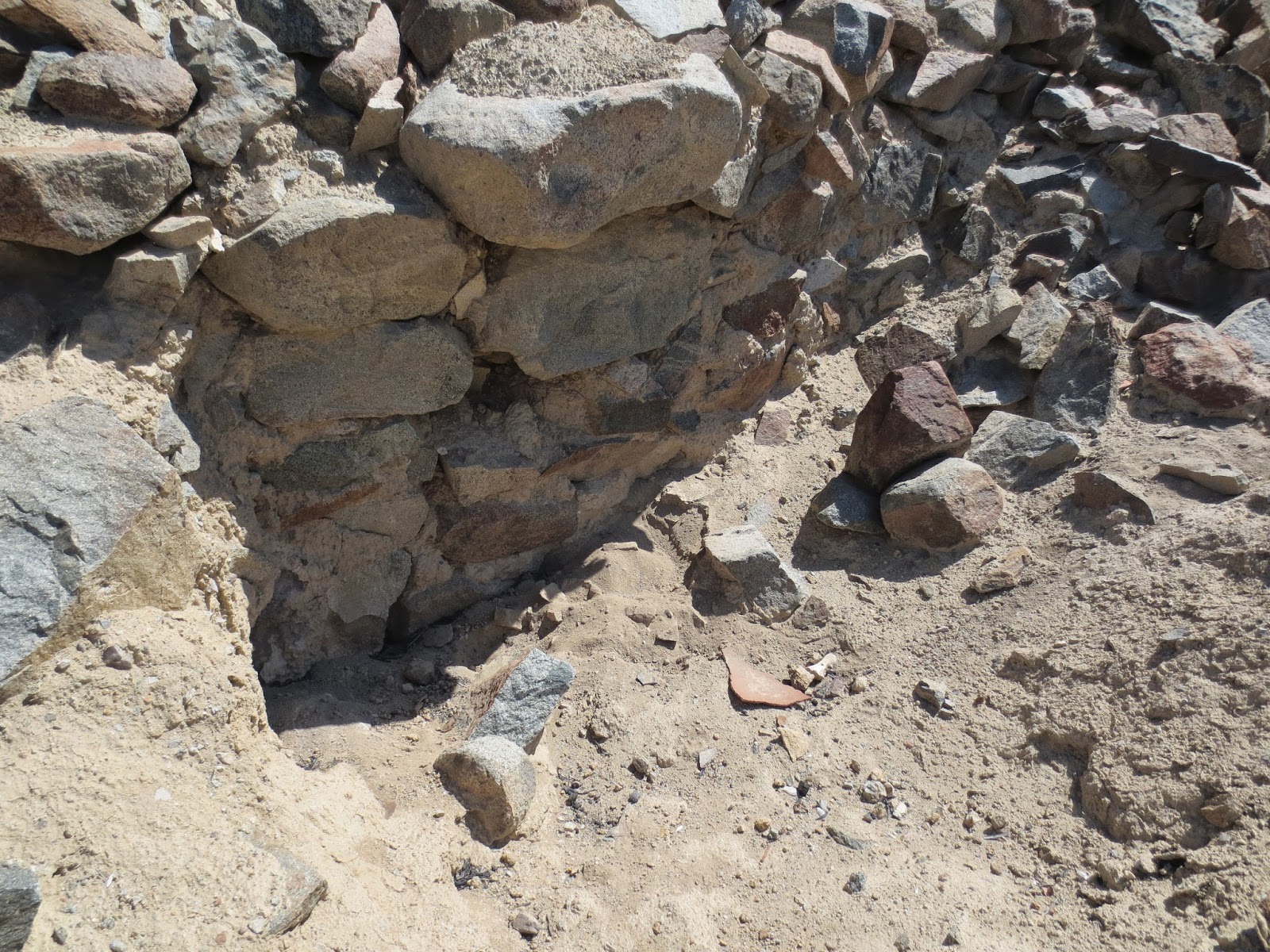 |
Wall exposed by unauthorized digging. Ceramic, bone,
and small muscle shell fragments just below center-right. |
There are only a few days left here in the field, and I look forward to examining several more sites in the mid-valleys of the Casma and Sechin branches of the Casma River. I expect to log a few more sites, leaving Casma with lots of excellent data for planning and funding a multi-year excavation project.
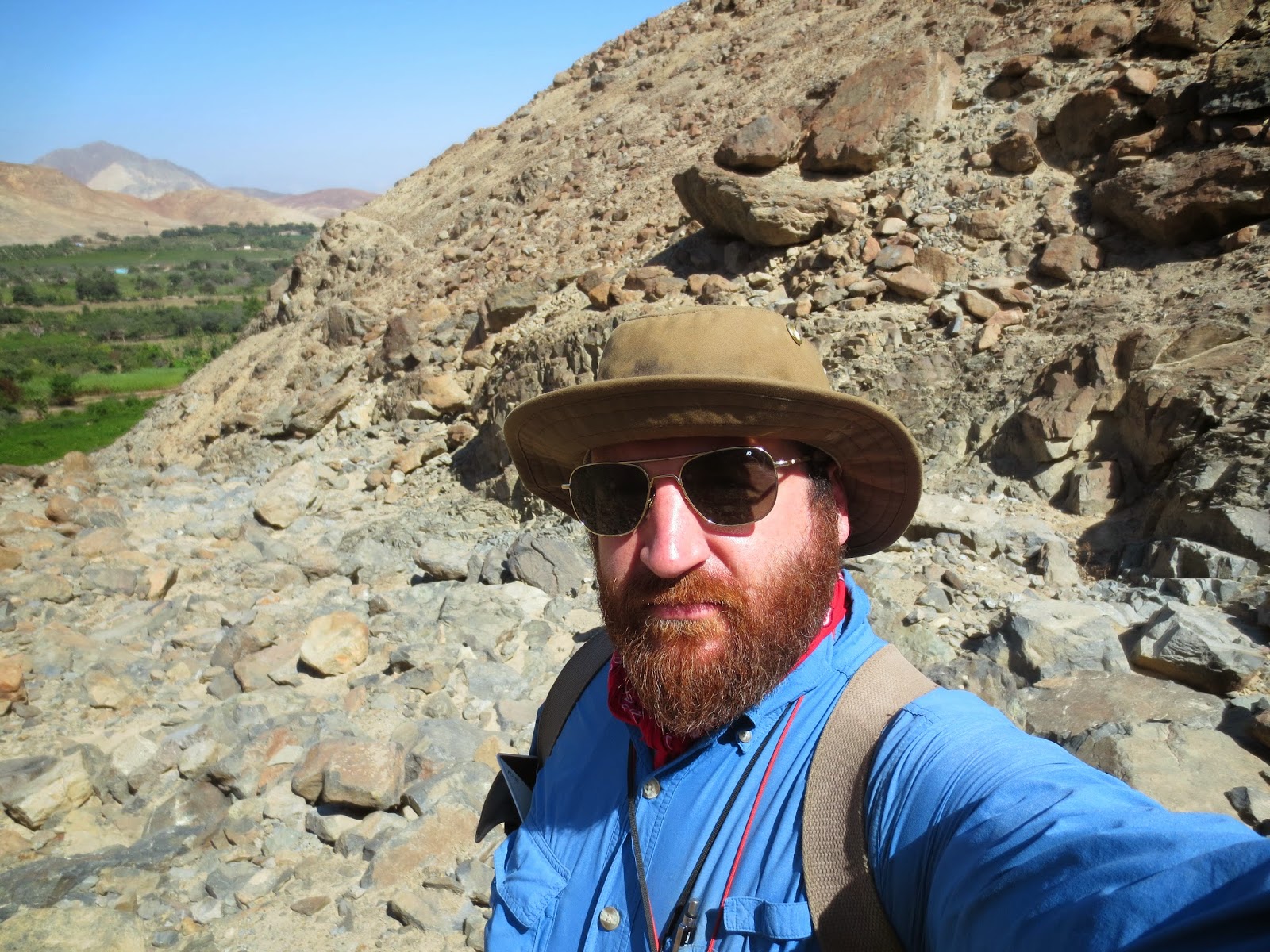 |
| Dave exploring a quebrada in the middle Sechin branch of the Casma River Valley |
References:
Pacifico, D. (2014). Neighborhood Politics: Diversity, Community, and Authority at El Purgatorio, Peru. Doctoral Dissertation, University of Chicago Department of Anthropology.
Vogel, M. (2012). Frontier Life in Ancient Peru: The Archaeology of Cerro La Cruz. University Press of Florida, Gainesville.
Vogel, M. and D. Pacifico (2011). Arquitectura de El Purgatorio: Capital de la Cultura Casma. In
Andes 8: Boletín del Centro de Estudios Precolombinos de la Universidad de Varsovia; Arqueología de la Costa Ancash edited by I. Ghezzi and M. Gierz (pp. 357-397). University of Warsaw, Warsaw.
